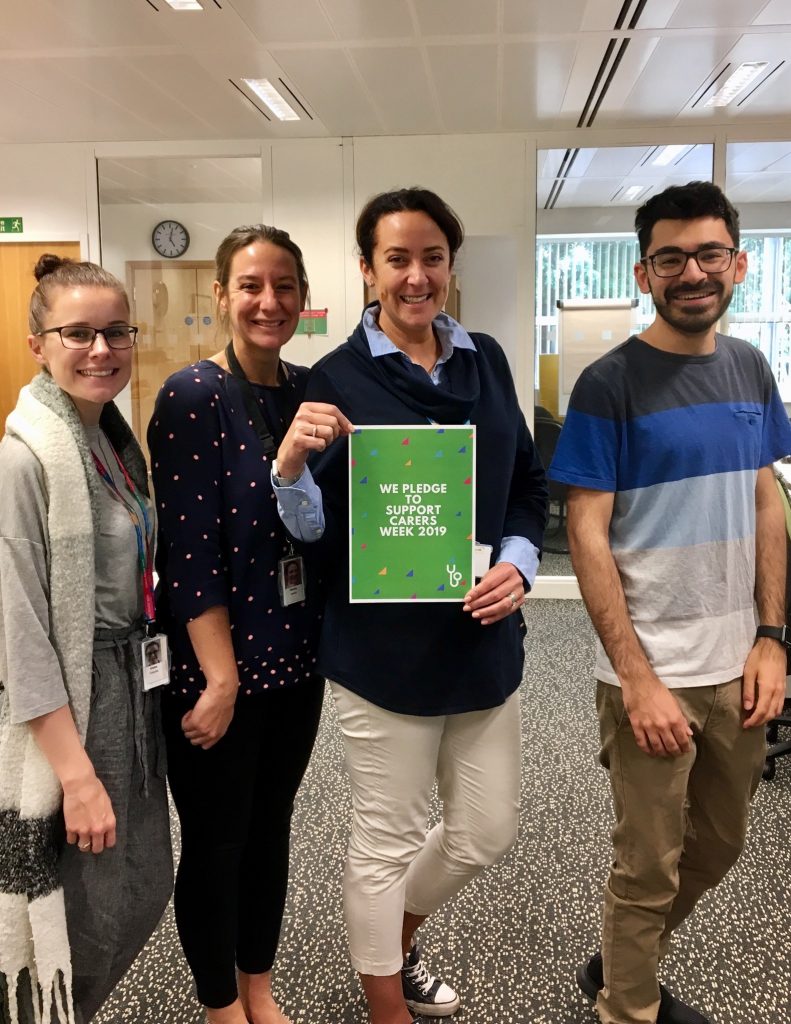
This Carer’s week we wanted to share our thoughts and experiences on supporting an employee who is also a carer.
Carersweek.org reported that 61% of those surveyed last year said they had suffered a physical ill health as a result of caring. What are you doing to support your employees that are carers?
A carer is anyone who cares for a friend or family member who is unable to cope without support due to illness, disability, a mental health problem or an addiction. This person is an unpaid carer. New figures suggest that unpaid carers looking after others living with an illness, disability, mental health condition or as they grow older are seven times more likely to be lonely themselves. Not being able to talk about caring leaves 1 in 3 carers socially isolated.
Carers cover such a wide spectrum of support; they could be a young person looking after a parent with a health condition or even an addiction, a middle-aged man caring for his partner who has a terminal illness, or an elderly woman looking after her husband who has Alzheimer’s disease (1).
Some employees may not be open about being a carer as they may be concerned that it will affect their employment relationship or status. For some, taking on a caring role can be an unexpected life changing circumstance. It’s important to be aware and in tune with your employee’s circumstances, and to be approachable as an employer and understanding so that the employee (carer) can get the support they need from their employer.
Likewise becoming a carer can be a gradual process, so carers don’t always recognise that they are classed as carers.

Carers can often see their support as just being a good ‘Friend’, a ‘Son’ or a ‘Wife’. The cared-for person struggles to recognise they are being cared for, this mindset can also have an impact on the carer.
In the workplace signs to look out for that an employee may be a carer:
If you notice a change, then proactively addressing the situation is vital. Whilst a carer does not legally have to notify their employer that they are a carer, a healthy work environment should enable an employee to do so. Take time in a suitable quiet environment to talk with your employee.
Questions you could ask an employee when understanding a change in circumstances:
Carers UK estimates that there are currently six and a half million carers in the UK – a number that continues to rise. 1 in 9 of your workforce will be a carer. More than 4 million carers provide up to 19 hours of unpaid care for a family member or friend each week, and more than 3 million are still in paid work. Many carers struggle to balance their work and caring responsibilities, others feel they have to make a choice between the two.
In a survey undertaken by the Chartered Institute of Personnel and Development (CIPD) in 2014, it revealed that 1 in 3 employers were reporting a rise in absence levels of workers taking time off for caring responsibilities, yet just 1 organisation in 6 had policies in place to help employees achieve a better balance between their home and working lives.
The most common form of support offered was flexible working arrangements (68%), followed by compassionate leave (53%) and (paid or unpaid) carers’ leave (48%). Two-fifths (42%) of the employers polled offered access to counselling services and 3 in 10 offered career breaks and sabbaticals. 1 in 6 offered access to financial services (17%) or options such as the purchase of additional annual leave days (15%).
Some employers were beginning to train their managers in how to manage absence and attendance better, covering topics such as mental health support. 1 in 3 employers had recognised the impact of caring responsibilities was having a moderate or considerable impact on absence levels and mental health / wellbeing.

After any period of absence, a Return to Work meeting is always a good mechanism for you to spend quality time with your employee to assess their wellbeing and identify any adjustments in the workplace / work pattern that need to be considered. Whatever the circumstances, maintaining a robust line of communication is key for the employer and the employee.
Questions you could ask an employee during a return to work meeting:
Statutory Rights
The right to a flexible working request
All employees have a right to request flexible working after they have worked for the same employer for 26 weeks, as long as they haven’t already made a flexible working request within the last 12 months.
As an employer you must have a sound business reason for rejecting any request.
Flexible working practices can be; flexi-time, home working, shift swapping, self-rostering, job sharing, part-time / term-time working, working compressed / staggered / annualised hours or even early retirement. Employers may also consider redeploying a staff member into a less stressful or more appropriate role as a way of keeping them well at work.
Having a carers’ policy to address the needs of people with caring responsibilities and to meet the requirements of the ‘right to request’ flexible working legislation is key. This policy should emphasise the benefits of flexible working arrangements, balancing work and personal life and employment breaks.
Time off for dependants
A dependant can be a partner, child or parent, or someone living as part of the family home. Others the individual may know who rely on help in an emergency may also qualify.
All employees have the right to have time off in emergencies or an unforeseen circumstance to care for any dependants. Employees have the right to take a ‘reasonable’ amount of time off work to deal with the emergency or an unforeseen circumstance involving a dependant. The time off is unpaid unless you as an employer is willing to give paid time off as a contractual right.
Examples of emergency situations could be; a disruption or breakdown in care arrangements, if a dependant falls ill or is in an accident, to make longer term arrangements for a dependant who is ill or injured (but not to provide long term care yourself)
Protection from discrimination – under the Equality Act 2010
Direct discrimination is where an employee or individual is treated less favourably than someone else because they are caring for an elderly or disabled person. In England, Wales & Scotland if an employee or individual is looking after someone who is elderly or disabled, under the Equality Act 2010 by law they are protected against direct discrimination or harassment because of their caring responsibilities. This is because they are counted as being ‘associated’ with someone who is protected by the law because of their age or disability.
Examples of potential discrimination could be; not offering someone a job because of their caring responsibilities, treating someone less favourably because of their caring responsibilities.
Contractual Rights
Contractual rights differ from contract to contract. It is important to check your contract of employment, staff handbook, HR policies or letter of appointment to see what the contractual rights are for an employee on top of their statutory rights. (2)

These are You HR Consultancy’s top tips for employers to take to ensure that carers are able to balance work life and their caring responsibilities
All these tips will support the development of a healthy work environment and one that nurtures all employees and especially those with carers responsibility. If you are experiencing levels of absence, attendance or low morale, these tips will help to improve the situation for you and help minimise / prevent further circumstances arising. Taking a proactive approach to nurture all employees will naturally increase retention thereby reducing recruitment, re- training and other associated costs as well as helping you become an attractive employer to others. (3)
Recognising the skills a carer can bring as an employee
Carers often have transferable skills which they have gained through their role as a carer. Some of these skills could be:
At You HR consultancy we have made the pledge to support Carers Week and the assistance we can offer to employers and employees. You could make the pledge too by clicking here.
If any aspect of our article has struck a chord with you or your employee’s circumstances, let us help you.
We provide Retained HR Support or Pay As You Go arrangements with expert advice on employment matters to help you in; developing Policies and Processes, designing and delivering e-learning or facilitated training to managers and employees, coaching and support for managers and team leaders, revising your current contract and handbook to make them more employer and employee focused, and much more. Get in touch to book your free HR Healthcheck with us by calling 01491 820767 or emailing alice@youhr.co.uk
You HR Consultancy has four key values to Listen, Understand, Action and Achieve for all our clients. Workplace Wellbeing is at the core of our passion to help SME, Not for Profit and Public Sector Organisations to reach their full potential through their most important asset…. their people! For us it really is “All about the people“.

